

 Tiếng Việt
 한국어
한국어 中文 (中国)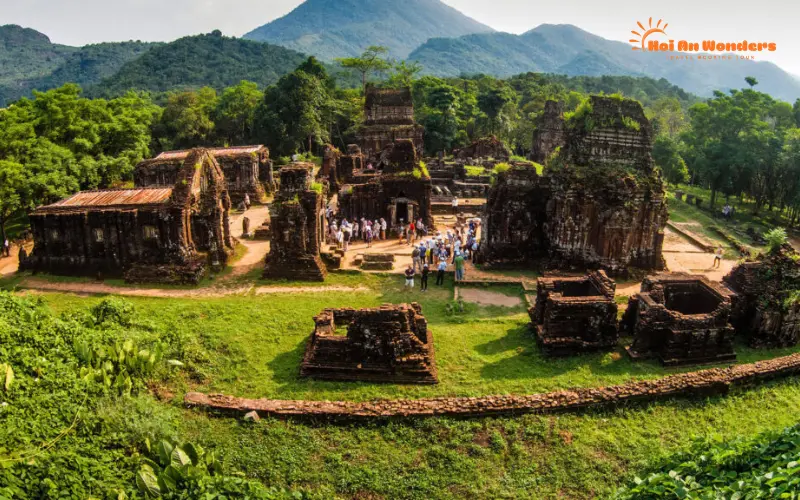







My Son Sanctuary Travel Guide 2026: Ticket Prices, Directions & Exploration
My Son Sanctuary stands as the most important complex of ancient Champa architectural and artistic heritage in Vietnam. In this comprehensive guide brought to you by Hoi An Wonders, we summarize all the latest information on ticket prices, the best travel routes from Da Nang and Hoi An, and provide an in-depth analysis of the historical and architectural significance of this fascinating temple complex.
Overview of My Son Sanctuary
Before visiting, let’s explore My Son Sanctuary and its history in detail to gain a better understanding.

Where is My Son Sanctuary located?
My Son Sanctuary is situated in an enclosed valley with a diameter of about 2km, surrounded by mountains and hills.
-
Exact address: My Son Village, Duy Phu Commune, Duy Xuyen District, Quang Nam Province.
-
Geographical distance: About 70km southwest of Da Nang city center and about 40km west of Hoi An Ancient Town.
History and Cultural Value
The My Son temple complex was the religious and spiritual center of the ancient Champa kingdom, spanning many centuries.
-
Establishment: Began in the 4th century under the reign of King Bhadravarman I (Pham Ho Dat). This king built a wooden temple to worship the god Shiva (under the avatar of Bhadresvara).
-
Development: From the 7th to the 13th century, successive Champa kings continuously restored and built more than 70 new temples using fired brick and stone.
-
Core belief: Deeply influenced by Hinduism. Shiva is the supreme deity worshipped, symbolizing destruction for rebirth.
-
Significant milestones: In 1885, the monument was discovered by French scholar Camille Paris. In December 1999, My Son Sanctuary was officially recognized by UNESCO as a World Cultural Heritage site.
Updated Ticket Prices & Opening Hours
To optimize cost and time, visitors should clearly understand the listed prices and operating hours of the relic site.
Detailed Sightseeing Ticket Prices
The ticket price includes visiting the entire temple complex, the electric shuttle bus (2km), and watching the Cham art performance.
| Category | Vietnamese Visitors | International Visitors |
| Adult (≥15 years old) | 100,000 VND | 150,000 VND |
| Child (5–15 years old) | 30,000 VND | 50,000 VND |
| Under 5 years old | Free | Free |
Note: Students carrying a valid student ID may be eligible for a discount policy at the ticket counter.
Opening Hours & Ideal Time to Visit
-
Opening hours: 6:00 AM – 5:00 PM (Open every day of the week, including Holidays and Tet).
-
Time of day: You should visit between 6:00 AM – 8:30 AM or after 2:00 PM. My Son Valley has very little shade from large trees, so visiting at noon will be very hot and tiring.
-
Ideal tourist season: From February to August every year. This is the dry season in Quang Nam; the weather is sunny and dry, making it convenient for road travel and outdoor photography. Avoid visiting from October to December, as this area is prone to the central region’s storms and heavy rains.

How to Get to My Son Sanctuary
The road to My Son is currently smoothly paved and spacious, making it easy for tourist vehicles ranging from 4 to 45 seats to travel comfortably.
Route from Hoi An
Hoi An is the most popular starting point to reach My Son.
-
Distance: 40km
-
Travel time: 1 hour
-
Route: From Hoi An center -> drive along Hung Vuong Street -> turn onto National Highway 1A (QL1A) heading South. At Nam Phuoc intersection (Duy Xuyen District) -> turn right onto Provincial Road 610 (DT610) -> Go straight for about 30km following the signposts to arrive.
-
Transportation: * Self-drive motorbike: Suitable for young travelers (rental price is about 120,000 – 150,000 VND/day).
-
Taxi/Grab/Private car: Costs range from 400,000 – 600,000 VND/way.
-
Half-day group tour: The most optimal choice for tourists; the all-inclusive price (transportation, tickets, guide) is only about 500,000 – 650,000 VND/person.
-
Route from Da Nang
-
Distance: 70km
-
Travel time: 1.5 – 2 hours
-
Route: From Da Nang center -> move along National Highway 1A (towards Quang Nam) -> Pass through Vinh Dien Town -> Reach Nam Phuoc intersection -> Turn right onto DT610 road (Hung Vuong Street, Duy Xuyen) -> Go straight to My Son Toll Station.
-
Transportation: It is highly recommended to rent a private tourist car with a driver or join a group tour from Da Nang to ensure safety and comfort, as the distance is quite far. Bus route No. 06 (Da Nang – My Son) is currently a cheap option but takes a lot of time (over 2 hours) to travel.

What Makes My Son Sanctuary Attractive to Tourists?
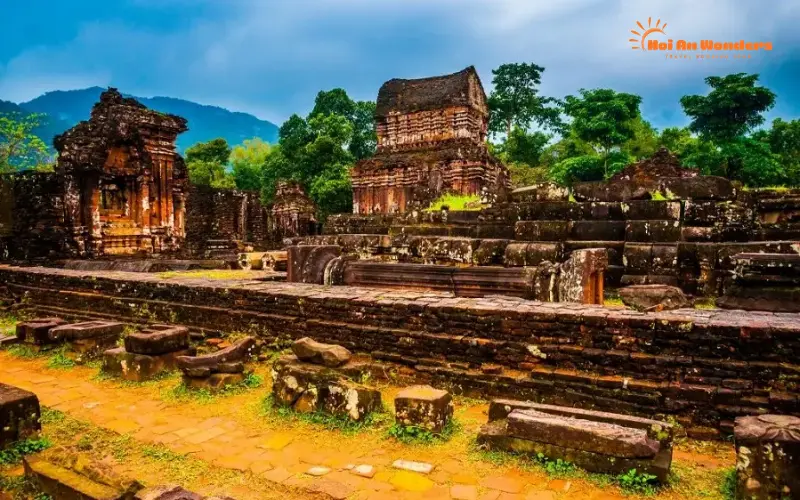
My Son Sanctuary does not have massive structures like Angkor Wat (Cambodia) or Bagan (Myanmar), but it possesses a mysterious, solemn beauty and contains unique architectural techniques.
Champa Temple Architecture
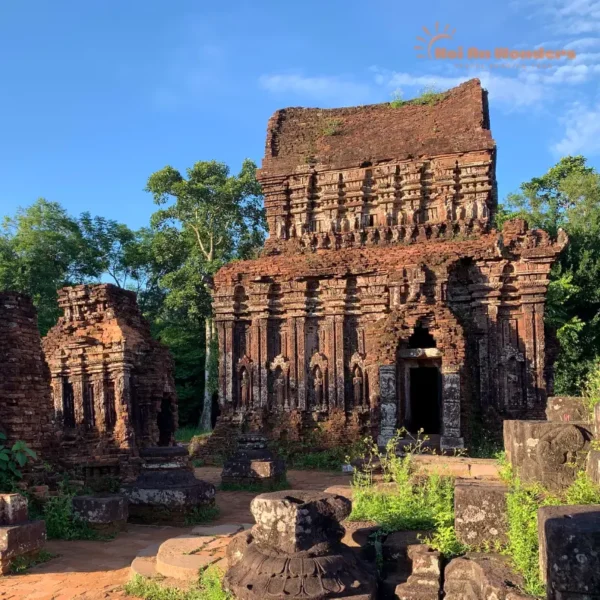
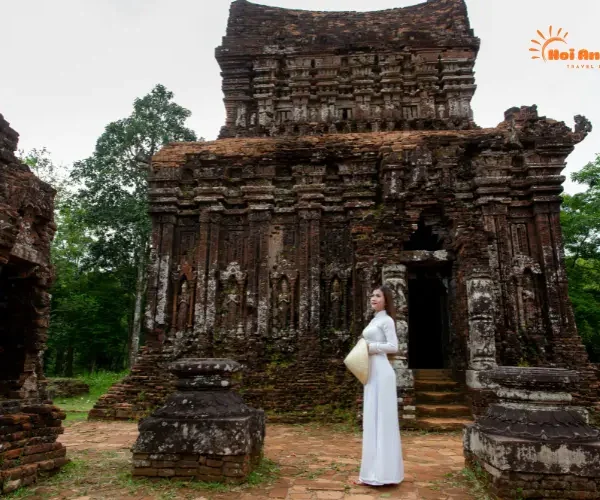
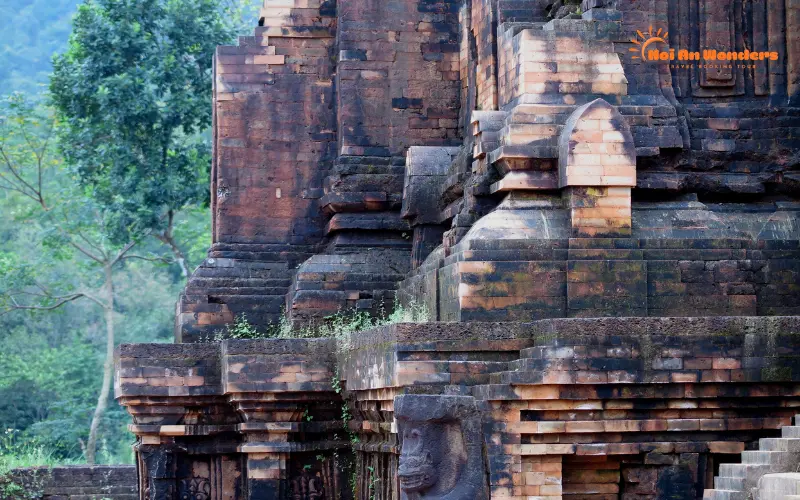
The entire complex is built of fired brick. What has puzzled scientists for centuries is that the ancient Cham people did not use mortar to bind the bricks together, yet the structures have stood firm for thousands of years.
Archaeological experts believe that the Cham people polished the bricks smoothly, stacking them so tightly that not even a knife blade could slip through. They then used a special tree resin (possibly dipterocarp resin) for binding before firing the entire structure.
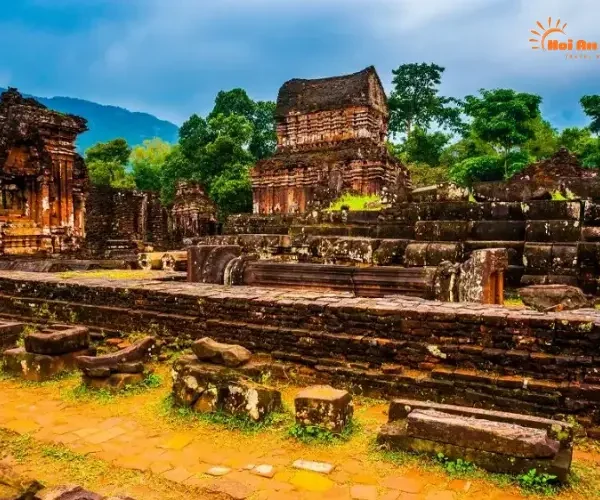
The My Son complex is divided into several temple clusters (Zones A, B, C, D, E, F, G, H). Among them:
-
Kalan structure (Main temple): Symbolizes Mount Meru – the center of the universe, the abode of the gods.
-
Gate tower (Gopura) & Fire tower (Mandapa): The places to prepare offerings before entering the main temple.
-
Zones B & C: The central area, concentrating many temples that still retain their most intact shapes. Notably, tower B5 features characteristic boat-shaped roof architecture.

Exquisite Relief Sculpture Art
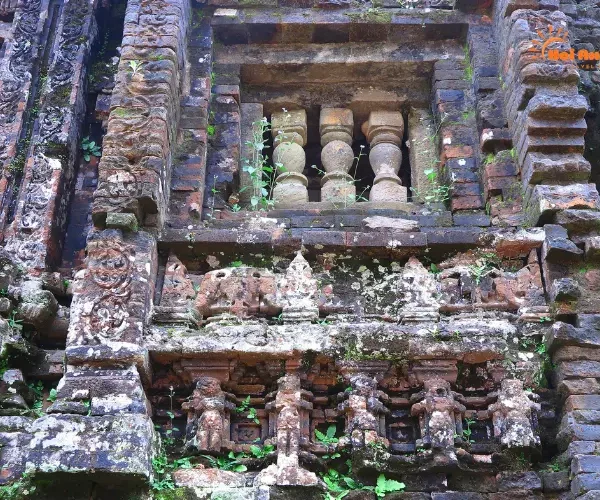
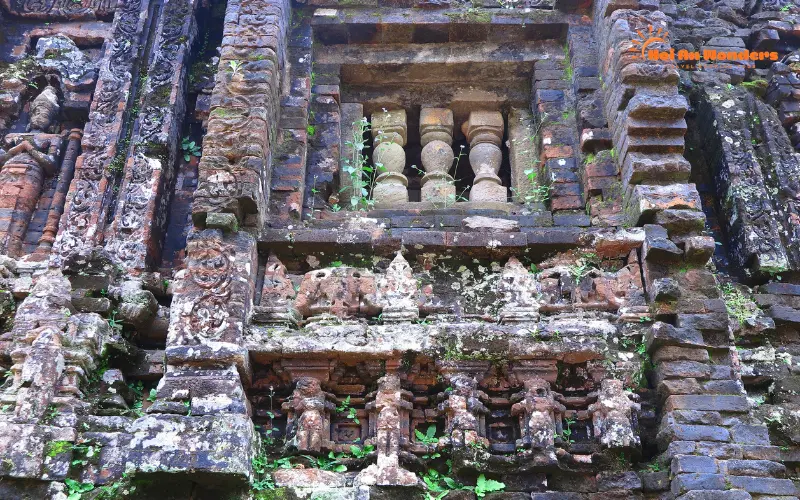
Champa art did not involve carving separate statues and then attaching them to the towers. They carved directly onto the solid fired brick walls. Visitors can witness firsthand the sculptures imbued with Hindu epics:
-
Makara and Kala reliefs: Symbols of time and the protection of the temples.
-
Statue of Lord Shiva: The god of destruction, usually represented through the Linga – Yoni altar (symbol of yin and yang, and fertility).
-
Apsara dancers: Reliefs of dancing fairies with graceful, soft curves carved directly onto a hard brick background.
Enjoy the Apsara Dance & the “Soul of the Temple” Show
To breathe life into the ruins, the My Son Management Board organizes Cham folk art performances right within the grounds at the foot of the towers.
-
Content: Recreating the legendary Apsara dances, water-carrying dances, and fire-biting dances. The dances blend with the resonant sounds of the Saranai trumpet and the deep beats of the Paranung drum.
-
Performance schedule (Fixed daily): Show 1: 9:15 AM, Show 2: 10:45 AM, Show 3: 2:00 PM, Show 4: 3:30 PM.
Note: Visitors should arrive 15 minutes early to choose the best seats for observation. The duration of each show is about 20 minutes.
Experience the Unique Kate Festival
If you travel to My Son in the 7th month of the Cham calendar (usually falling in late September or early October in the Gregorian calendar), you will have the opportunity to participate in the Kate Festival.
This is the largest festival of the year for the Cham people to commemorate the gods, kings, and ancestors. The festival includes rituals of costume procession, statue bathing, singing folk songs, and traditional folk games, attracting tens of thousands of attendees.
Suggested 1-Day Itinerary for My Son Sanctuary
Below is a practical itinerary designed to optimize your time and energy for a day trip:
-
06:30: Depart from Hoi An. Have a quick breakfast with Banh Mi or Bun Thit Nuong (grilled pork noodles).
-
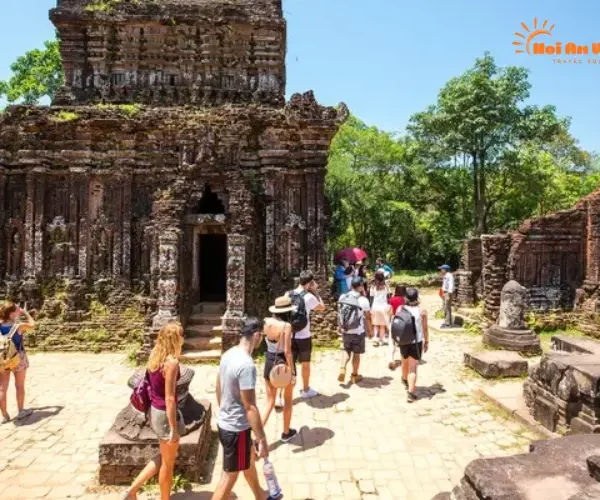
07:45: Arrive at the My Son Sanctuary gate. Purchase tickets, check in, and take the electric shuttle (2km) to the central monument area. Walk along a small dirt path through the forest.
-
08:00 – 09:00: Visit Zones B, C, and D (the best-preserved temple clusters). Listen to a tour guide explain the mortarless bricklaying technique and the significance of the Linga-Yoni altar.
-
09:15: Head to the performance area to watch the traditional Apsara dance show.
-
09:45 – 10:30: Continue exploring the remaining areas (Zones E, F, G). Take photos at the cinematic, moss-covered, ruined architectural corners.
-
11:00: Board the electric shuttle to leave the relic site.
-
12:00: Have lunch in the Nam Phuoc District area. Enjoy local specialties like Phu Chiem Mi Quang (Quang-style noodles) or Cau Mong Barbecued Veal (famous dishes along the DT610 route).
-
13:30: Get in the vehicle and return to Hoi An. End of a fulfilling half-day tour.

Essential Tips for Visiting My Son
To ensure a smooth trip, you need to adhere to certain regulations and prepare carefully:
-
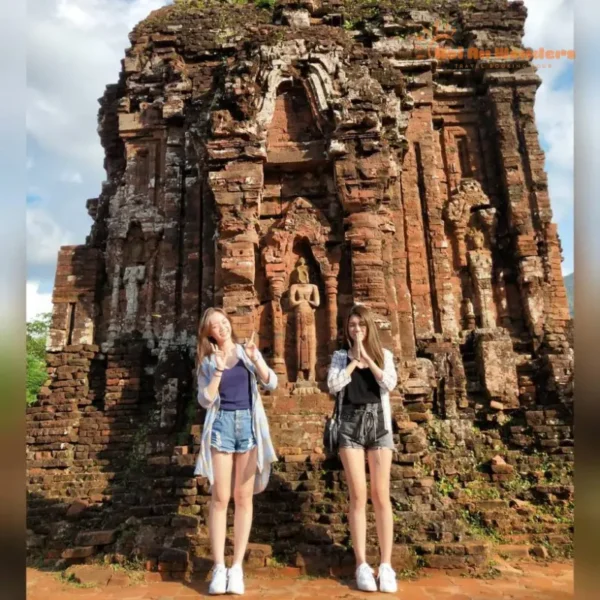
Dress Code: My Son is a religious and spiritual site. It is mandatory to wear modest clothing, including shirts with sleeves and pants/skirts that cover the knees. Do not wear spaghetti straps or tight shorts.
-
Footwear: Wear sneakers or comfortable flat shoes. You will be walking quite a distance on dirt paths and steps after getting off the electric shuttle.
-
Sun & Insect Protection: The sun in Central Vietnam is very harsh. Apply sunscreen, bring a wide-brimmed hat, and wear a jacket. Because the area is surrounded by forests and mountains, apply insect/mosquito repellent before entering.
-
Monument Protection: Absolutely DO NOT touch, rub, or climb on the ancient brick walls. The brick structures have weathered for thousands of years and are highly fragile.
-
Drinking Water: Bring a large bottle of water with you. To protect the landscape, there are very few refreshment stalls inside the core of the monument area.

Should You Visit My Son Independently or Take a Tour?
This is a common question for many tourists when planning to explore My Son. Each option has its own pros and cons, depending on the needs and age of your group.
Independent Travel
-
Pros: You have complete control over your time. You can linger longer at beautiful photo spots or freely detour to local eateries along the way (such as Phu Chiem Mi Quang or Cau Mong Barbecued Veal). This is highly suitable for young travelers who enjoy backpacking and exploring the rural roads of Quang Nam.
-
Cons: You must navigate on your own and take responsibility for traffic safety (especially if departing from Da Nang, which is a 70km journey). The biggest drawback is the lack of historical context. My Son is a complex of ruins; without a guide, it is difficult to grasp the cultural depth, and you may only see moss-covered piles of bricks.
Joining a Group Tour
-
Pros: The most valuable aspect is having a tour guide. Their systematic explanations about the mortarless bricklaying technique, the meaning of the Linga-Yoni altar, and the Champa dynasties will help you truly appreciate the site. It is also convenient and safe, offering door-to-door transportation and an optimized schedule so you won’t miss the Apsara dance show. Furthermore, it is cost-effective. The price of a half-day group tour (which usually includes transportation, the 100k – 150k entrance ticket, drinking water, and a light meal) is actually much cheaper than renting a taxi and buying tickets on your own.
-
Cons: You must strictly follow the group’s meeting times and cannot stay too long in one specific area.
Recommendation: For highly specific historical and archaeological destinations like My Son Sanctuary, the best choice is to book a group tour (half-day or full-day). If you still prefer to travel independently to control your schedule, consider hiring an on-site tour guide (available at the ticket counter) so that your trip provides genuine educational value, rather than just a superficial glance.
Thông tin liên hệ:
- Địa chỉ: Rừng Dừa Bảy Mẫu, Hội An Đông, Đà Nẵng
- Website: https://hoianwonders.vn
- Facebook: https://www.facebook.com/dulichhoianwonders
Hopefully, this comprehensive My Son Sanctuary travel guide, updated for 2026, has helped you prepare perfectly. Whether you depart from Da Nang or Hoi An, and whether you choose an independent trip or an all-inclusive tour, this sacred valley will undoubtedly provide you with profound cultural experiences completely distinct from other eco-tourism or entertainment destinations.